
The Evil Eye in Indian Homes: What Nazar Means and Why It Makes a Good Gift
Team Felofey · 5 Oct 2026
Where the evil eye comes from, what nazar means in Indian households, where people actually hang one, and why it is one of the few gifts that is never awkward.
Almost every Indian household has one somewhere — a lemon and chilli at a shop door, a black dot on a baby’s cheek, a blue glass eye hanging from a rear-view mirror. The form changes; the idea does not.
Nazar is the belief that admiration, even well-meant, can carry a weight that harms. The charm absorbs it, so the new thing or the new baby does not.
Where the blue eye comes from
The blue-and-white eye, the nazar boncuğu, is Mediterranean and Turkish in origin and thousands of years old. It travelled with trade and settled comfortably in India beside much older local customs — the kala tika, the nimbu-mirchi, the handprint on a new wall.
They coexist because they answer the same worry in different vocabularies. Which is also why nobody finds it strange to receive one.
Where people actually hang one
- The front door. The most common place by far. It faces outward, because that is the direction the gaze comes from.
- A car. Hung from the mirror or clipped to the keys, usually the week the car is bought.
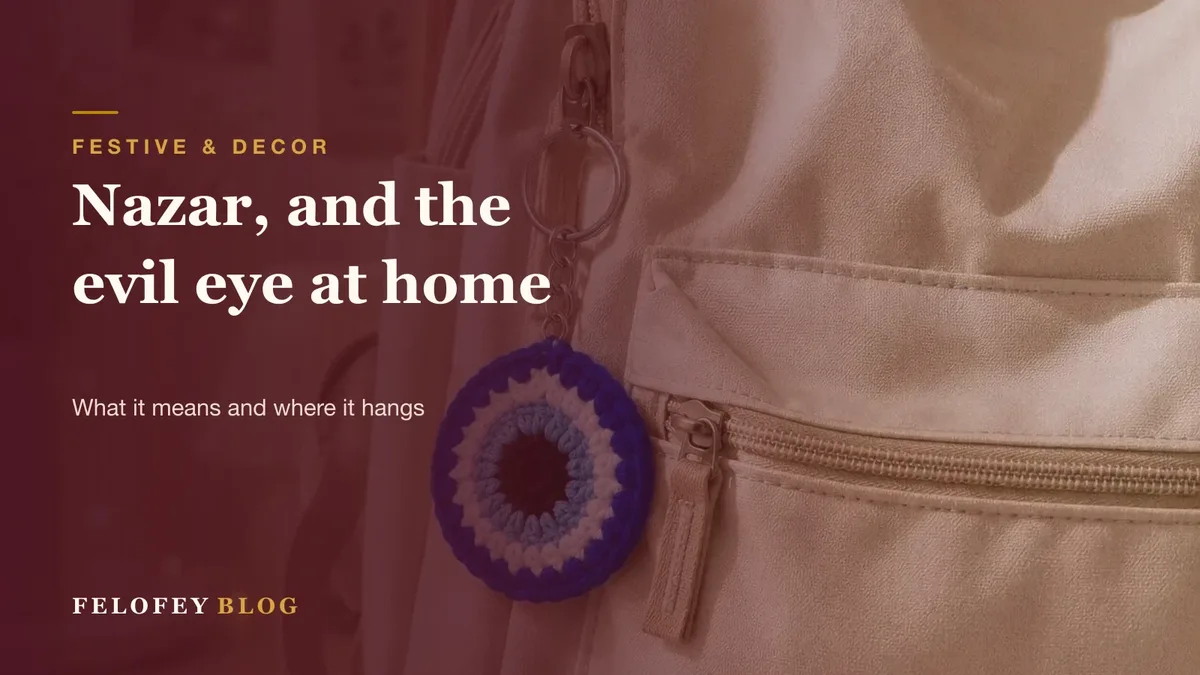
- A bag or keys. The portable version, which is why an evil eye keychain is the format most people reach for now.
- A baby’s room. Out of reach, and often alongside a kala tika.
- A new shop or desk. The first thing many people put up on day one.
Why it is a safe gift
Most gifts carry some risk of being wrong — wrong size, wrong taste, wrong colour for their room. An evil eye carries almost none, for three reasons.
- It means something without being religious. Families of every background hang them, which is unusual for a symbolic object.
- It attaches to a moment. A new home, car, job or baby — occasions when people most want one.
- It needs no space. It hangs. In a small Delhi flat with no free surfaces, that matters.
It is also why evil eye charms are among the most ordered items for Griha Pravesh and for a new car.
Why crochet rather than glass
The traditional charm is glass, which looks beautiful and breaks. On a set of keys or a child’s bag that is a real limitation.
Our crochet evil eyes (₹169) are worked in cotton yarn, so they survive being dropped, sat on and carried in a bag. They come in blue and white — the traditional palette — and green and blue. Soft enough to sit against a phone screen, which glass is not.
A note on belief
Plenty of people hang one without believing in it at all, in the same spirit as touching wood. That is fine, and it is part of why it works as a gift: the person receiving it does not have to share a belief to appreciate the gesture.
If you know the household keeps strictly to a tradition that would not include one, pick something neutral — coasters or a flower pot instead.
Common questions
Which direction should an evil eye face?
Outward, towards the door or the street. The idea is that it meets the gaze before the gaze reaches the house.
What if it breaks?
Tradition says a broken charm has done its job and should be replaced. One practical advantage of a crochet one is that it does not break in the first place.
Is it only for new homes?
No — a new car, a new job, a newborn, a new shop. Any beginning.
Can I give one to someone of a different faith?
Usually yes; it is cultural more than religious across most of India. If you are unsure about a particular household, choose something neutral.
See both colourways on the keychains page, handmade at Felofey in Delhi.
- #evil eye
- #nazar
- #evil eye gift
- #nazar battu
- #evil eye keychain
- #protection gift india
- #felofey
- #evil eye meaning